
Press Release
New CWCI Study Looks at California Workers Comp Medical Dispute Resolution
A new study by the California Workers’ Compensation Institute estimates that workers’ compensation payors’ utilization review (UR) programs, which rely on evidence-based medicine, combined with the new Independent Medical Review (IMR) medical dispute resolution process, approve more than 95 percent of all medical treatment requests.
New reforms and current events in California workers’ compensation have generated a debate over the proportion of medical treatment requests that are approved, modified and denied by insurance companies and self-insured employers, though until now, there has been no hard data to advance the debate beyond hyperbole. The Institute analysis uses special data sets to assess:
- how prevalent the use of elevated UR and IMR are in California workers’ compensation;
- what types of services are subjected to elevated UR by a physician and IMR;
- the distribution of medical treatment decisions by type of medical service; and
- what proportion of treatment requests are approved, modified and denied.
Interviews with claims and managed care experts from CWCI member insurers and 5 UR companies operating in California found a consensus that the availability of the state’s Medical Utilization Treatment Schedule and other evidence-based treatment guidelines and tools allows 3 out of every 4 treatment requests to be approved during the initial review by claims adjusters, nurses and others, while 25 percent are sent on for elevated UR by a physician.
Calif. WC Medical Treatment Requests, Elevated UR and IMR Dispute Resolution
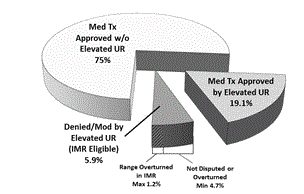
Additional data from a sample of 919,370 elevated UR requests and decisions made by insurers during the 18 months ending in June 2012 further show that an additional 19 percent of the treatment requests are approved at this level. Finally, data on the IMR treatment requests and outcomes gleaned from 1,141 IMR determination letters posted on the Division of Workers’ Compensation were used to estimate the impact of IMR. At current IMR decision rates, if all 5.9 percent of the treatment requests that were denied or modified by elevated UR went through IMR review, 1.2 percent would be overturned, reducing the overall treatment denial/modification rate to 4.7 percent.
Additional analyses, tables and findings from the study are included in CWCI’s full report, “Medical Dispute Resolution: UR and IMR in the California Workers’ Compensation System,” which is posted in the research section of the Institute’s website at http://www.cwci.org/.