
Cost-Driver Medications: The $1,000 Drug Club
One feature of CWCI’s Prescription Drug Interactive Application allows users to identify the average amount paid for drugs dispensed to Calif injured workers in a given calendar year. The latest update to the app shows the average amounts paid for prescriptions filled during each of the 14-1/2 years spanning 2010 through June 2024. The app includes the % of prescriptions, % of payments, average payments, and % brand for all drugs that had 30 or more prescriptions dispensed in a calendar year. A breakdown of that data by drug ingredient reveals a dozen drugs with average payments of at least $1,000, as noted below.
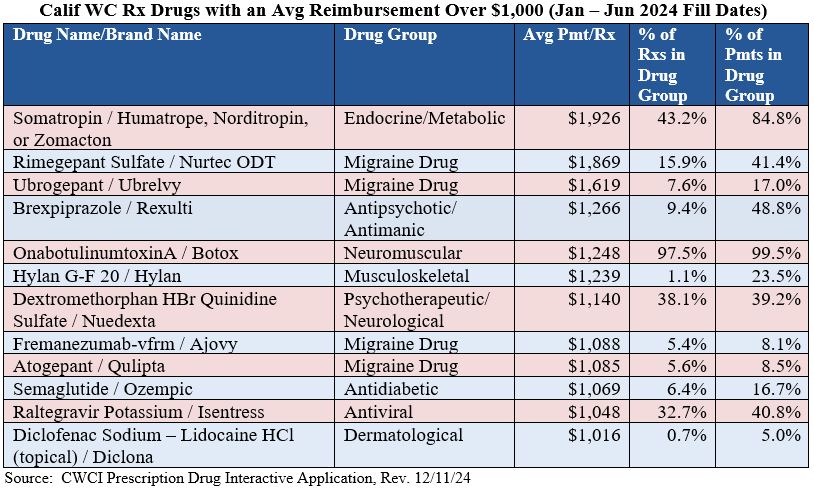
Several of the $1,000+ drugs should sound familiar. Four are heavily marketed Migraine Drugs (Nurtec, Ubrelvy, Ajovy, and Qulipta) highlighted in our October 2024 Spotlight report, while physician-administered Hylan is an injectable viscosupplement noted in our July 2023 study on low-volume/high-cost Musculoskeletal Drugs. Diclofenac Sodium–Lidocaine HCL (Diclona), dispensed as a gel, a patch, or in a “tape kit,” is one of the private-label topicals linked to the emergence of dermatologicals as the costliest drug group in California workers’ compensation in the first half of 2024 (CWCI Bulletin 25-02).
Among the other drugs that had an average reimbursement of $1,000+ in the first half of 2024 are:
- Somatropin (Humatrope, Norditropin, or Zomacton), a human growth hormone that had the highest average reimbursement ($1,926);
- Brexpiprazole (Rexulti), another heavily marketed brand drug used to treat major depressive disorder and schizophrenia;
- OnabotulinumtoxinA (Botox), an injectable neuromuscular drug sometimes used to prevent headaches, muscle stiffness in the elbow, wrist and fingers, and incontinence;
- Dextromethorphan HBr Quinidine Sulfate (Nuedexta), a psychotherapeutic/neurological drug used to treat Pseudobulbar Affect, which causes involuntary, sudden and frequent episodes of crying and or laughing in people living with certain neurologic conditions or brain injuries;
- Semaglutide (Ozempic), the weight loss drug used to treat obesity and diabetes; and
- Raltegravir Potassium (Isentress), one of the brand-name antiviral drugs used as part of the drug “cocktail” used to treat HIV as well as for occupational postexposure HIV prophylaxis.
While the use of these drugs may be appropriate for an injured worker (e.g., a worker with a spinal injury might be prescribed Ozempic if they need to lose weight before back surgery, or a nurse suffering a needle stick while treating an HIV patient might be prescribed Isentress), these drugs are not very prevalent in workers’ compensation. Ten of them are categorized as “Not Listed” drugs by the MTUS Formulary, so they may be allowed if the physician can show that their use for the specific injury is supported by the MTUS or other applicable treatment guidelines. The other two drugs, Brexpiprazole (Rexulti) and the Dextromethorphan HBr Quinidine Sulfate (Nuedexta), are categorized as “Non-Exempt” drugs, so they are subject to prospective utilization review.
The preceding table showed each of these drugs’ share of the prescriptions and payments within its therapeutic drug group, but their combined share of all California workers’ compensation prescriptions dispensed in the first half of 2024 was less than 1%, indicating that they tend to be brand-name specialty medications used on a very limited basis. However, because of their high average payments, these 12 drugs consumed 11.5% of the total drug spend during that 6-month span, and that percentage more than tripled from 3.3% in 2020 as many of these new, high-priced drugs were introduced. This, along with the potential for serious drug interactions and side effects associated with many of these medications, makes it imperative that medical providers, claims administrators, pharmacy benefit managers, and utilization reviewers carefully examine how and when these drugs are prescribed and weigh the alternatives to ensure that their use for a given injury is appropriate and supported by nationally recognized treatment guidelines.
As a CWCI member, we invite you to visit our website (www.cwci.org) to check out the Prescription Drug Interactive Application, which is one of seven interactive applications that CWCI members can access by logging on with their username and password. (If you haven’t set up a member account, select “Your Account” at the top of the home page, click “Add me as a Member User” from the pull-down menu, complete the form, then use the information to log in). If you need assistance, call 510-251-9470. Once you are logged on, use the drop-down menu under the Research tab on the home page, click “Interactive Research Applications” then” scroll down to the “Prescription Drug Interactive Application – Updated 12-11-24” and click that title. This will open the initial tab, “Opioids: Claim-Level Use by Development Period.” Clicking the second tab at the top of the screen will open the “Opioids: Distribution of Top Drugs by Service Year.” The third tab provides the Distribution of Prescriptions and Average Payments by Therapeutic Drug Group by service year (based on the fill date); and the fourth tab shows the Service Year Detail by Therapeutic Drug Group and Drug Ingredient. The first four tabs include filters for selecting different metrics and changing the exhibits so users can build customized views. There is also a fifth tab that describes the data and methods used to develop the app.
As new data becomes available, CWCI updates its Apps to provide you with current data. The next updates are scheduled for June 2025 and will include data through December 2024.
BY/