
IMR Update Through Q3 2022
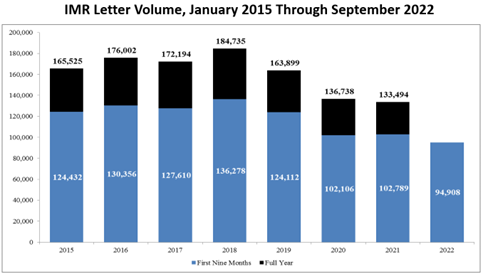
The Institute has completed our latest analysis of Independent Medical Review (IMR) activity based on data from more than 1.2 million determination letters issued from January 2015 through September of this year, of which 94,908 were issued in the first three quarters of 2022. After declining 2.4 percent between 2020 and 2021, the number of IMR letters issued in the first three quarters of this year fell 7.7 percent compared to the same 9-month period of last year according to the latest data.
The new results suggest that 2022 will be the fourth year in a row that IMR volume will decline, continuing a downtrend that began in 2019 after the state added the Chronic Pain and Opioid Guidelines into the MTUS in late 2017 and implemented the MTUS Prescription Drug Formulary in 2018, leading to a sharp reduction in pharmaceutical disputes – most notably those involving opioids. The decline in IMR volume continued in 2020 and early 2021 as the economic effects of the pandemic led to fewer work injury claims, but by the second half of last year the state’s economy had largely reopened and the number of IMR determination letters had begun to climb again, with IMR letter volume through the first three quarters of 2021 exceeding the comparable 2020 level. However, as noted in the chart below, IMR letter volume fell to an 8-year low of 94,908 in the first three quarters of this year and appears to be on track to hit a record low for the year.
The data on IMR outcomes shows the IMR uphold rate through September of this year was 91.0 percent, which remains within the same narrow range of 88.2 percent to 92.0 percent where it has been since 2015. As usual, uphold rates continue to vary by the type of medical service requested, ranging from 81.7 percent for psych services to 95.7 percent for injections.
Looking at the year-to-year changes in uphold rates by treatment category shows the biggest declines were in lab services, where the IMR uphold rate fell from 87.4 percent in 2021 to 82.8 percent during the first three quarters of this year, and in psych services where the uphold rate fell from 85.1 percent to 81.7 percent, while the biggest increase was noted in acupuncture, where the uphold rate rose from 90.5 percent to 93.4 percent. Among pharmaceutical IMRs, which accounted for 33.8 percent of all IMR determinations through September of this year, the uphold rate fell from 92.9 percent in 2021 to 91.3 percent in the first three quarters of 2022.
The table below notes the IMR distributions by medical service category for 2015 through the third quarter of 2022, as well as the change in the uphold rate between 2021 and the first nine months of this year.
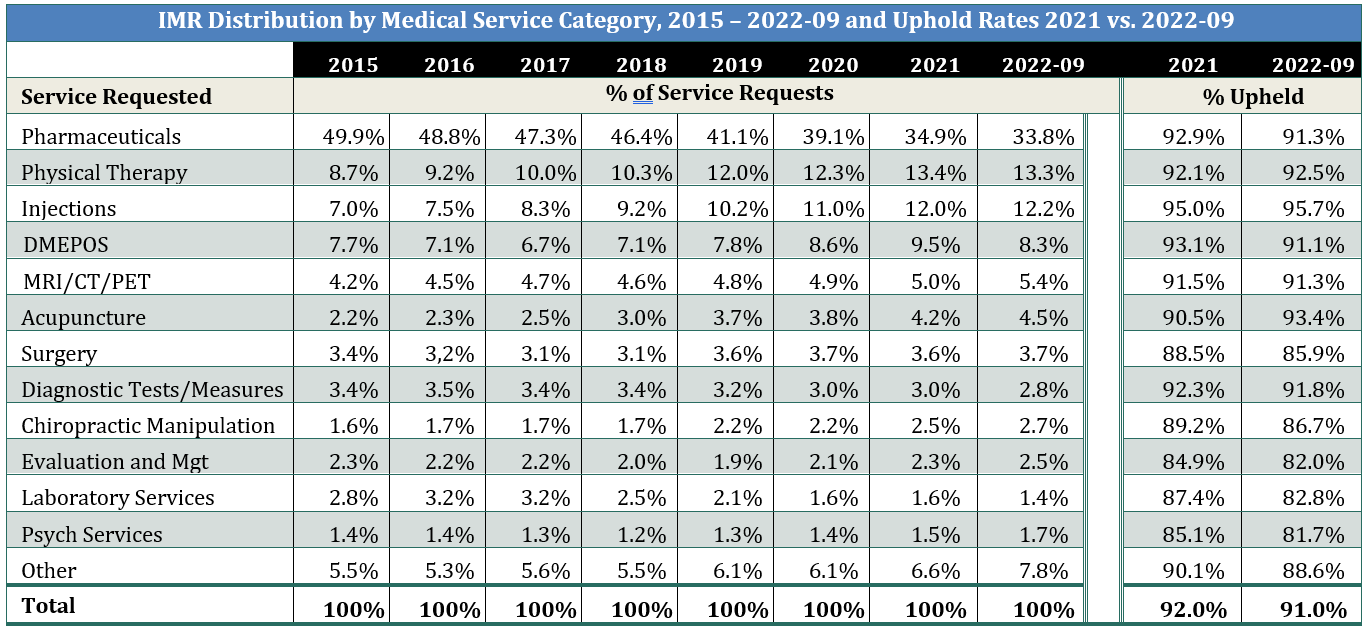
Pharmaceutical requests fell to a record low 33.8 percent of the IMR decisions in the first three quarters of 2022, but they still accounted for more IMRs than any other type of medical service, ranking well ahead of PT, which accounted for 13.3 percent of all treatment disputes submitted for IMR in the first three quarters of this year; injections which accounted for 12.2 percent; DMEPOS which accounted for 8.3 percent, and MRI/CT/PET scans which accounted for 5.4 percent. No other service category represented more than 5 percent of the IMRs in the first three quarters of 2022, though acupuncture, surgery, chiropractic manipulation, E&M, and psych services all saw their share of the IMRs increase slightly compared to 2021.
Looking at the distribution of prescription drug IMRs by drug category shows that even with the formulary and the Opioid and Chronic Pain Guidelines, disputes over opioid requests still top the list, accounting for 24.7 percent of pharmaceutical IMRs in the first three quarters of 2022, though that is down from 32.2 percent in 2018, when the formulary first took effect. At the same time, the uphold rate for opioid IMRs has ticked up from 89.5 percent in 2018 to 91.7 percent over the first nine months of this year, though that rate was down from 93.1 percent last year. Musculoskeletal drugs continue to rank second (17.6 percent of the pharmaceutical IMRs, with a 98.4 percent uphold rate); followed by dermatologicals, which were up to 17.2 percent of the prescription drug IMRs vs. just 10.9 percent in 2018, even though the uphold rate on dermatological drug request modifications and denials through September of this year was 96.0 percent – second only to musculoskeletal drugs. Anticonvulsants continue to represent about 1 out of every 10 pharmaceutical IMRs, which is up from 8.1 percent in 2018, when the formulary took effect, but the IMR uphold rate for anticonvulsants has jumped from 80.4 percent in 2018 to 92.0 percent in the first nine months of 2022.
A small number of high-volume providers continue to represent a disproportionate share of the IMR requests. The top 10 percent of requesting physicians named in the IMR letters from the 12 months ending in September 2022 (803 providers) accounted for 83.0 percent of all disputed service requests resolved during that period, while the top 1 percent (80 providers) represented 39.7 percent. A closer look at the provider concentration shows that the 10 doctors with the highest number of IMR decision letters issued during the 12 months ending September 30, 2021 were linked to 20,923 service decisions during that period (10.8 percent of the total), even though 91.2 percent of the UR decisions involving these doctors were upheld.
CWCI continues to monitor IMR activity and will publish full-year results for 2022 once the data is available. In the meantime, CWCI members can log in to www.cwci.org and click Independent Medical Review under the Research menu to view a series of exhibits that are regularly updated with quarterly IMR data.