
Updated IMR Data Through Q3 2025
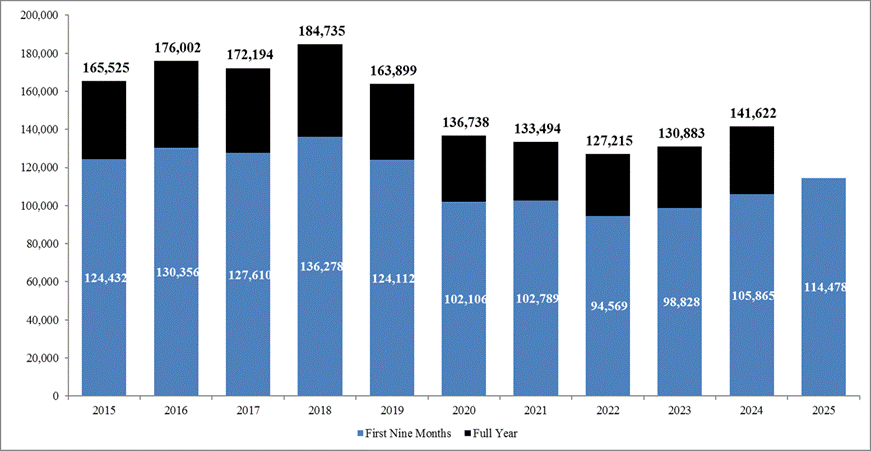
CWCI has finalized and posted its latest update of Independent Medical Review (IMR) activity based on data from nearly 1.65 million determination letters issued from January 2015 through September 2025, including 114,478 issued in the first three quarters of this year. After hitting a record low in 2022, then increasing 2.9 percent in 2023 and 8.2 percent in 2024, the number of IMR letters issued in the first three quarters of this year rose 8.1 percent compared to the same 9-month period of last year according to the new data.
The latest results suggest that 2025 will be the third year in a row that IMR volume will increase following a 4-year downtrend that began in 2019 after the DWC added the Chronic Pain and Opioid Guidelines into the MTUS in late 2017 and implemented the MTUS Prescription Drug Formulary in 2018, leading to a sharp reduction in pharmaceutical disputes, especially those involving opioids. The decline in IMR volume accelerated after the pandemic hit in 2020, but by the second half of 2021 the California economy had begun to recover and the IMR letter count edged up, so the total IMR letter volume for the first three quarters of 2021 exceeded the comparable 2020 count. IMR letter volume then fell to a historic low of 127,215 during the post-pandemic economic boom in 2022 before heading back up in each of the past three years.
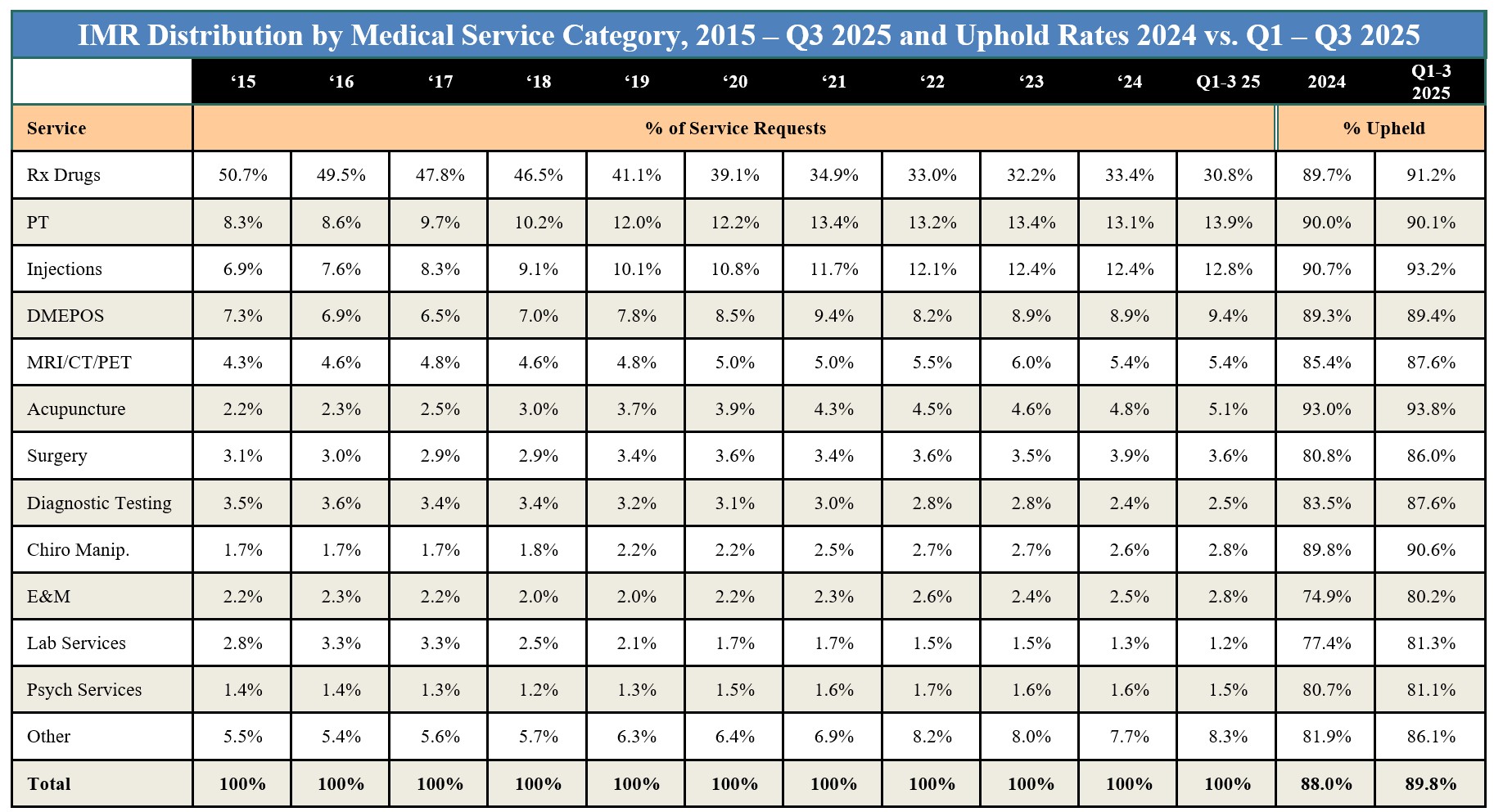
The IMR outcomes data show that the overall uphold rate for UR denials and modifications in the first nine months of 2025 was 89.8 percent, which is within the same narrow range of 88.0 to 92.4 percent where it has been since 2015. Uphold rates continue to vary by type of medical service, ranging from 80.2 percent for Evaluation and Management (E&M) requests to 93.8 percent for Acupuncture requests. Increased uphold rates were seen across all service categories, with the biggest increases noted in E&M, where the IMR uphold rate jumped from 74.9 percent in 2024 to 80.2 percent in the first three quarters of this year, and in Surgery where the uphold rate increased from 80.8 percent to 86.0 percent. Among Pharmaceutical IMRs the uphold rate rose from 89.7 percent in 2024 to 91.2 percent in the first nine months of 2025.
Pharmaceutical requests fell to a record low 30.8 percent of the IMR decisions in the first three quarters of 2025 but still represented more IMR disputes than any other type of medical service, with more than twice the proportion noted for PT, which represented 13.9 percent of the treatment disputes submitted for IMR in the first three quarters of this year. Injections ranked third with 12.8 percent; followed by DMEPOS which accounted for 9.4 percent; MRI/CT/PET scans which had 5.4 percent; Acupuncture which accounted for 5.1 percent; and Surgery which represented 3.6 percent. No other service category accounted for more than 3 percent of the IMRs in the first three quarters of 2025, though Diagnostic Testing, Chiropractic Manipulation, and E&M all saw their share of the IMRs increase slightly compared to 2024.
The distribution of Pharmaceutical IMRs by drug category shows that, for the second year in a row, dermatological drug disputes topped the list, accounting for a record 25.0 percent of Pharmaceutical IMRs in the first three quarters of 2025, up from 22.2 percent in 2024, and more than double the 12.3 percent noted in 2018, the first full year after the Chronic Pain and Opioid Guidelines were added to the MTUS and the formulary took effect. Since those changes were made, the uphold rate for Dermatological IMRs has ranged between 92.3 percent and 95.8 percent, and it is holding within that range this year, coming in at 93.9 percent for the first nine months of 2025. Opioids again ranked second, but they continue to represent a dwindling share of the prescription drug disputes, accounting for 18.6 percent of the Pharmaceutical IMRs in the first 9 months of 2025, down from 20.8 percent last year, with a 95.1 percent uphold rate. Musculoskeletal drugs ranked third, with 17.1 percent of the prescription drug IMRs in the first three quarters of this year, even though the uphold rate on musculoskeletal drug request modifications and denials through September was 98.7 percent – the highest among all drug categories. For the sixth year in a row, anticonvulsants accounted for about 1 out of every 10 pharmaceutical IMRs, which is up from 8.2 percent in 2018, when the formulary took effect, but notably the uphold rate for anticonvulsant denials and modifications has jumped by more than 12 percentage points from 80.7 percent in 2018 to 92.8 percent in the first nine months of 2025.
A small number of high-volume providers continue to represent a disproportionate share of the IMR requests. The top 10 percent of requesting physicians named in the IMR letters from the 12 months ending in June 2025 (814 providers) accounted for 84.4 percent of all disputed service requests resolved during that period, while the top 1 percent (81 providers) represented 42.1 percent. A closer look at the provider concentration shows that the 10 doctors with the highest number of IMR decision letters issued during the 12 months ending September 30 of this year were associated with 24,663 service decisions during that period (11.1 percent of the total), even though 90.8 percent of the UR modifications and denials involving these doctors were upheld.
CWCI continues to monitor IMR activity and will publish full-year results for 2025 once the data is available. In the meantime, members who log on to our website at www.cwci.org can access a series of 10 slides showing the updated IMR statistics through September 2025 by clicking Independent Medical Review under the Research tab on our homepage.
BY/